
Showing posts with label animals. Show all posts
Showing posts with label animals. Show all posts
Wednesday, September 1, 2010

Wednesday, June 23, 2010
Thursday, April 15, 2010

Thursday, October 29, 2009

Friday, September 4, 2009
TUESDAY. AMBOSELI NATIONAL PARK.


Egyptian goose at a watering hole.
You must be in a covered vehicle to visit Amboseli National Park. Ol Donyo Wuas has one covered Range Rover so one group will visit every day for a week. Hilary and her pals were the first to go and reported that giraffe and elephant walk right up to the jeep. They had a wonderful lunch that Moses prepared on the top of a grassy hill overlooking the park.
Our day came and Ron, Michael, Paul, Kip and I set out for the two-hour drive to Amboseli after breakfast. We were familiar with most of the drive after visiting a town near the park a few days earlier so the trip doesn’t feel very long.
Our guide, Jonathan, informs us that we can’t get out of the jeep for any reason once we enter the park. Not even to pee. That news delights me because I hate peeing in the bush. The other rule is that you must stay on the road. No off-roading is allowed.
We stop inside the gate so Jonathan can pay. A few Maasai are ready to trade or sell. Michael buys a few bracelets. Jonathan returns and we drive into the park. Not far in, we see three small giraffe on the side of the road, their legs akimbo drinking out of a small watering hole. It was the first time that I wanted to get out of the jeep.
The land is more what I expected Africa to look like; dusty roads and flat, dry land surrounded at great distances by mountains.
There’s a herd of elephant heading our way. Jonathan stopped the jeep on the road and we wait. The elephants get closer and closer walking in single file or in pairs just like in Dumbo. They get closer but not louder. There’s barely a rustle as they pass in front of us, tusks rocking back and forth, feet padding along the ground. There is a baby surrounded by older elephants in the middle of the pack. We coo and purr over it. Several young males are trailing behind protectively. The last elephant passes silently in front of us and we drive to a palm tree grove.

We all have to pee, so Jonathan turns onto a path with a “do not enter” sign through thick trees whose palms stretch in all directions.
After a few turns we enter a clearing of neat tents with elephant skulls lining the paths between them. Jonathan parks and two men approach and welcome us. After taking care of business, we are given a tour of the Elephant Rescue camp.
It’s a 30-year-old project and each elephant in Amboseli has a name and is watched and protected by the organization. The elephant skulls are from animals that died naturally, even the tiny skulls. On one of the biggest skulls you can see the honeycomb cartilage that houses their brains. That's why the elephant’s head is actually very light. They don't have a heavy skull.


We leave the elephant preserve camp and drive around the park. Jonathan slows at a pond with reeds and stops. The boys and I are talking and comparing binoculars when Jonathan turns around and says, “Pea-pole. Hip-owe time.”
We look at the pond and a largue head with tiny ears appears above the water’s surface. Hippos.
It’s dusty and we’re getting hungry but Jonathan keeps driving around the park. We help a white mini-van stranded on the road by pulling it until the engine starts. Maybe they’re Germans. Possibly English. Their teeth are pretty bad but their clothes are kind of hip.
Once the van disappears, Jonathan turns off the road and across a bumpy patch of ground. He says it’s an elephant crossing. The mud with deep elephant tracks has hardened into ruts, making the jeep jostle and bounce so much that we have to hold on tight so we don’t fly out. I was getting annoyed and a little sick when the ground evened out and we stopped bouncing.
I said, “Jonathan, shouldn’t we have lunch?” with a whine that I couldn’t cover.
Spying a lone tree in the cracked, dry desert, Jonathan drives toward it. It is the only thing standing as far as we could see, even in the wavy marsh heat of the day. Jonathan stops under the little shade the tree provides and quickly unpacks lunch and opens a bag with cokes and ginger beer telling us the tree is called “fever tree,” a special tree that has survived the destruction of the elephants.
Jonathan puts the makings for sandwiches on the hood of the jeep. I’m opening containers with Focaccia bread and sliced ham and cheese. The guys are a short distance away taking pictures.
I walk to where Ron is standing and whisper, “Where’s my mountain picnic with tree-trunk seats and a view of the park Hilary told us about?”
From behind me, Jonathan says, “I see movement.”
I run to the jeep and hand Jonathan my binoculars. Putting the glasses to his eyes, he scans the horizon.
“Cheetah,” He says. “Pack up.”
Everyone’s in motion throwing meat and bread back into bags and drowning our drinks as we pile into the jeep. Jonathan jumps behind the wheel and we takes off across the hot desert. The tires loose traction as we drive onto a moist watering hole and pass one, two, three, four, five, six cheetah. They walk single file, hunched over looking at us drive right next to them. There’s just enough moisture on the ground to send us swerving in front of the cats.

“It’s a mother and her cubs,” says Jonathan coming to a stop a couple of feet away from the animals. They stop and look at us, panting. We don’t have good cameras but we try and get off a few shots as the cheetah family turns away and slowly bounce back the way they had come. When they reach a grassy area with cape buffalo and impala, one by one they sit down in the tall grass. We follow slowly and stop a short distance away.


“Wow,” is all any of us could manage.
The mother moves ahead of her cubs into the tallest grass in the area. The cubs watch the impala and cape buffalo. We watch them. And the mother watches everything. Unable to shake us, she stands and walks away. The cubs follow until she stops at a fallen tree, its white branches bare and bone-like against the grass.
Lunch is a distant memory.
All six cats drape themselves across the branches and turn to look at us.
Ron says, “An art director’s dream.”
Wednesday, July 15, 2009
THURSDAY. MARKET DAY.
Ostriches.




Zebra.
Kori Bustard. Because they are so heavy, they tend to walk more than fly. Bustard means birds that walk.
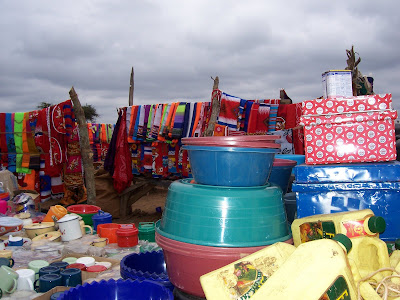
It’s a long bumpy jeep ride before we arrive at the Maasai village and the open air market. I’m uncomfortable because I feel like a rich American among the poor Maasai. It’s as if anything the West brings only works if it’s money. Western clothes—jeans and t-shirts—look dirty and dingy. Traditional Maasai clothes are bright and colorful red and purple wraps that look beautiful against the dark skin and long limbs of the Maasai. The women wear elaborate beads and the warriors carry walking sticks or spears. I see Moses, my favorite guide, wearing a green linen shirt and pressed pants and realize that what they wear is irrelevant. Guides are paid pretty well. So, again, it comes down to money.
 Schools and medicine are always welcome. We visited a few schools on our way to the market. The religion that paid for the school becomes the faith of the students. Presbyterian. Catholic. Lutheran.
Now that I want to spend my dollars at the market, I realize that I’ve foolishly spent all of my money at the little shop at the lodge. All I can do is admire the bright fabric and the Artful Dodger, Stephen, who charms and smiles for the most gum and trinkets from our party.


After wandering through the market looking at coffee, potatoes, clothes, shoes, sandals made of tires, bright patterned fabric, and children wanting, we go to the cattle market where the men are packed in a corral buying and selling cattle and goats.
Clare buys a dark brown goat for the staff at the lodge. It’s a beautiful little thing and I’m afraid it will be slaughtered and served for our dinner. LeDoux thinks the same thing so we decided to ride in a different jeep on the return trip. We ride with Moses.
The Range Rover dies a few times on the way home, once when Moses stops for me to pee behind a huge tree called the wait-a-minute because the branches catch on your clothes and stop you in your tracks until someone comes to release you from its grip. Moses being Moses, jumps the gears and gets us going from a dead stop. With the Chyulu Hills in sight, we see a group of ostrich and Moses slows down.
“Don’t stop,” We yell. “We don’t need to stop!”

Tuesday, July 14, 2009
WEDNESDAY.


A lone Grants Gazelle on the prairie. Larks and shrikes in the trees. A pale chanting Goshawk looks like an eagle but with a yellow beak and gray feathers.

Moses lets Hilary drive the Range Rover and they sing, “Jambo. Jambo Bwana. Hakuna Matata.” We bounce in the jeep past Acadia trees on our way home as the sun goes down.
Monday, July 13, 2009
TUESDAY P.M. GAME DRIVE.


 Wattled Starlings—light grey with yellow around the eyes.
Oryx.
Gerenuk.
On the drive home from the sundowner, it’s dark but the sky is ablaze with the Southern Cross. A giraffe appears on the road in front of us. It runs in our headlights as we drive slowly behind it. Curve after curve of the road go under the giraffe’s hooves as it gallops in the dim beams of light. I think that it’s frightened.
Saturday, July 11, 2009
ZEBRA.


Grants Gazelles stand in a patch of sun with perfect twisted horns. Moses says that they lose their black stripe as they get older.
We’re a little tired after an afternoon game drive under the African sun. Driving toward Kilimanjaro, Ron yelps as a butterfly flies into his face, searing his cheek. We’re looking at Ron when tiny specks in the distance suddenly grow. Our first herd of Zebra. And Gazelle. Wildebeest. Hartebeest. There were none and then there were many. I know Zebra from zoos and pictures. But they look more unnatural in the wild. Like black and white striped cartoon animals sticking out from the green. Moses points out the Wildebeest and Hartebeest before giving us a lesson.
Kongoni or Coke’s hartebeest can go up to two months without water. On the open plains we see two light brown and white rumps. The one with the bulging sides is pregnant. The other might be the mate. We like to think they are partners.
Zebra are non-ruminant animals like horses, and wildebeest are ruminants like cows. The animals graze together because they eat different parts of the grass. Their teeth grow in the opposite direction so they aren’t competing for the same food.
Zebras live in family groups with the stallions at the head. Their call of flight and call to gather the herd sounds like a donkey’s bray. At least the movie donkeys that I’m familiar with. Zebra stripes are like fingerprints. Moses says that the black stripes have fat underneath them that absorb heat and the white stripes repel heat so they regulate their temperature, making them drought resistant.
Africa is an evolution soup.
Bethlehem skies flood the plains as light filters through the clouds. We are surrounded by hundreds of Zebras. Two little ones wag their striped tales against their striped butts. We drive closer and a group of black and white heads looks up and walk toward us.
Everyone can’t help but squeak, “They’re so cute.”
Another mighty and goofy wildebeest shows up and bucks and twists as he runs. It’s a crazy, energy wasting way to move, more like be-wilder-beast, comic and outrageous. Legend has it that the wildebeest was the last of God’s creations so was made with the spare parts of other animals. Its head is a buffalo’s. The lump on its back is a cow’s. And it runs like a horse.
The herd is on the move as a low thunder of hooves surrounds us like wind would sound if it landed.
Moses tells us that the Burchell zebra, or common zebra, were named after the first naturalist to visit South Africa in the early 1800s, William John Burchell. The Grevy zebra was named after the President of France in 1882, Jules Grevy. I have lots of questions, but I let them go not wanting to break the spell the zebras have over me.
On our way to the lodge, back to the now-familiar trees of the Chyulu Hills, we see a bright blue roller and an orange bird with a long beak. Moses picks up a dung beetle for Ron.
From the elephant to the beetle, it’s as if the baffling worlds of cosmology and molecular biology surrounds and confounds us at every turn.
Saturday, March 21, 2009
Panda-monium

Thursday, December 11, 2008


Subscribe to:
Posts (Atom)